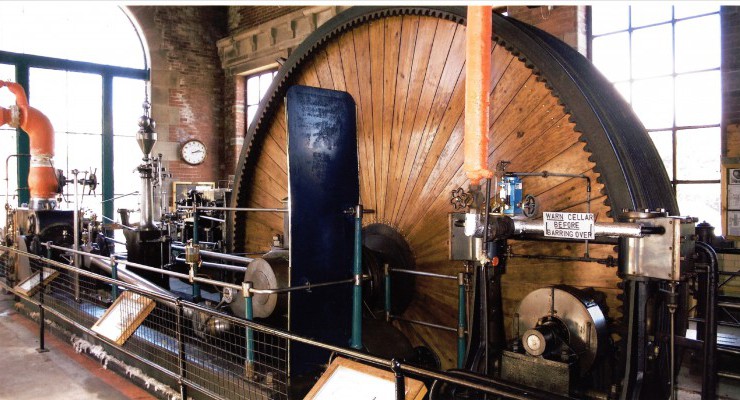
Bancroft Mill Engine 2026
Lancashire
This is the story of what made St Helens 'great' from its humble beginnings to its rise as a world leader in glass making. Explore the underground tunnels of one of the world's first continuous regenerative tank glass making furnace built in 1887 by William Windle Pilkington. Glass was blown in large cylinders then cut, flattened and polished into large sheets. English Heritage say it is the best surviving example in England. It is a Grade II* Listed building.
Address: Chalon Way East St Helens Lancashire WA10 1BX
Wed-Sun & BHol 1000-1600. Summer: closes 1700. Visit website or facebook for more details.
St Helens isn’t only Glass, there was a thriving coal community, as well the opening of the Sankey Canal in 1757, and its later extension to Ravenhead, goods flooded back and forth between St Helens and Liverpool. Local industries benefited from the flow of coal, copper ore, salt and limestone.
The local clays of St Helens have been worked for hundreds of years. By the late 1800s, St Helens boasted several large scale potteries and brickworks. The principal ones were Doulton’s, Roughdales Fire Clay Co. Ltd and the Sutton Heath Pottery. Between them they produced everything from bricks and chimney pots to sanitary pipeware, tiles, flower pots and coarse earthenware mugs, sugar moulds and stoneware bottles.
Lancashire
Lancashire
Lancashire
Lancashire
Lancashire
Lancashire