
15th Mar 2012 / 10:42am
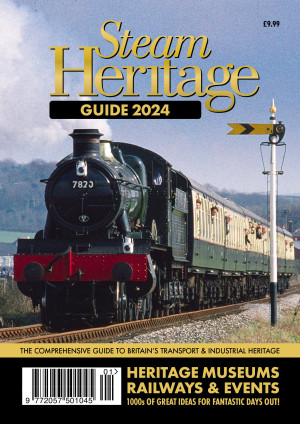
The 2012 Steam Heritage Guide has arrived from the printers and is being sent out to mail order customers.
Full of information on 830 museums, heritage railways & attractions, as well as 1200 events, this is the 'must have' Guide for this year.
There is a wide variety of places to visit, from railways, to car, lorry and bus museums, maritime museums and steam ships on which you can take a trip, and aviation museums where you can enjoy the sound of powerful engines being run up. All in all, iin this Jubilee year, this Guide is an essential companion to a fantastic year of nostalgia!
To make your visits more economical, several places also offer excellent discount entry vouchers, so don't miss out!
In addition to the Guide being available by mail order, we have managed to secure a deal through our newstrade distributors for copies to be sold through branches of WH Smith, as well as a host of independent retailers.
Trade customers can order direct from us or via Severnside Wholesalers on the Isle of Wight.
2nd Nov 2011 / 6:10pm
The historic Pleasley Pit has won a prestigious national award, highlighting the Derbyshire site as the finest restored industrial building in the country.
The Pit has received an English Heritage Angel Award. The awards, which were launched and part funded Lord Andrew Lloyd Webber are probably the country’s most important heritage prize, they celebrate the work of individuals and groups who have saved a significant historic place that was at risk of being lost forever. The award is deserved recognition for The Pleasley Pit Trust, who have worked tirelessly for over fifteen years on the restoration of the former colliery.
Andrew Lloyd Webber chaired the judging panel which comprised Simon Thurley, Chief Executive of English Heritage, author and broadcaster Melvyn Bragg, Charles Moore of the Telegraph, historian Bettany Hughes and the Bishop of London, the Right Revd Richard Chartres.
Andrew Lloyd Webber said: “All 16 shortlisted groups were exceptional and the judges had a hard time deciding between them. But in the end the winners stood out for their passion, perseverance and imagination, for the scale of the challenges they had taken on and for the legacy they leave behind – a secure future for beautiful historic buildings which without them could so easily have simply disappeared.
Work on multi-million pound project to transform a disused colliery site and bring it back into beneficial use for the local community was undertaken with investment from East Midlands Development Agency (emda) via the Homes and Communities Agency’s (HCA’s) National Coalfields Programme. The restoration project has cleaned up the industrial dereliction left over from the closure and demolition of the Colliery in the 1980s, and created a landscaped gateway entrance to the Pleasley Pit Country Park. It has also enabled the restoration of the ancient monument that marks the glory days of the mining era. The site is now in the ownership of the Land Trust who provide the Pleasley Pit Trust with advice and support on the management of the historic site.
The Land Trust has also been given funding for the long term management of the site. As Euan Hall, Chief Executive at the Land Trust, explained: “The Land Trust is a community led organisation. We protect the investment made in restoring sites like Pleasley and ensure that when a community group such as the Pleasely Pit Trust put their heart and soul into a project their work is supported. Vitally we can also say that thanks to emda’s and HCA’s funding, the future of this heritage Angel is secured and we are able to support to the Pit Trust in the management of this valuable site for many future generations.”
Graham Dobbs, Head of Area at the HCA, commented: “It is great that Pleasley Pit has been recognised nationally. Our funding has meant that a former dilapidated site can now be used by the community, and provide a valuable asset that not only pays respect to the mining heritage, but also adds to the long term sustainability of the site.”
The Pleasley remediation project has spanned several phases over the past few years. The initial phase involved the remediation of the land and development work on the site, including landscaping and construction of a car parking facility.
Phase two focused on the conservation of the site’s key features, including the remaining colliery engine houses and the iconic head gears, along with other Grade II listed structures.
The Pleasley Pit Trust has been instrumental in the restoration work. Speaking on their behalf, Bob Metcalfe said: “The changes to the buildings and site are quite unbelievable. 15 years ago the place was a mess floor plates missing, engine parts missing, trees growing through parts of the engines, the remaining part of the roof on the verge of collapse, everything covered in rust and pigeon guano. The future of the buildings and structures is now assured”, says Robert. “A whole generation who will never know ‘how it used to be’ will at least to be able to marvel at these survivors of the great age of steam.”
25th Oct 2011 / 9:28am
Poll shows 80% think it is as Important as Castles and Country Houses
The largest ever research project into the condition of England’s industrial heritage was recently published by English Heritage together with its annual Heritage at Risk Register. It reveals that:
listed industrial buildings are more at risk than almost any other kind of heritage. Almost 11% of grade I and II* industrial buildings are at risk, an extraordinarily high number compared to the 3% of grade I and II* buildings which are at risk in England
40% of listed industrial buildings at risk, such as mills, warehouses and factories, could be put to sustainable and economic new uses. The remaining 60%, typically buildings that contain historic machinery, redundant engineering structures or mining remains, are of immense cultural value and often greatly loved. These have the power to unite local communities and although not easy, there are countless examples that have been saved by committed local groups as conserved sites in the landscape often with public access or as visitor attractions
lead, tin, copper and coal mines are the industrial sites most at risk on Register. Textile mills also make up a large proportion and these buildings are often concentrated in a single place – Lancashire, Greater Manchester and West Yorkshire. The remains of 20th century industries are poorly understood, under-appreciated and very much at risk
most industrial heritage sites at risk in the North East are things which are not capable of being converted for new uses, indeed 54% are connected to various forms of mining. Most industrial heritage sites at risk in the East of England are wind and watermills and most in the South East are maritime structures.
A poll of public attitudes to industrial heritage which English Heritage also published today shows that:
almost half the population (43%) do not know when the industrial revolution took place
however, 86% agree that it is important we value and appreciate industrial heritage
80% think it is just as important as our castles and country houses
71% think industrial heritage sites should be reused for modern day purposes as long as their character is preserved
only 9% considered it depressing or an eyesore.
Simon Thurley, Chief Executive of English Heritage, said; “Britain led the way in global industrialisation and as a result we are custodians of the world’s most important industrial heritage. It is, however, one of the elements of our heritage most at risk.
“Forty percent of these buildings could be reused to house new advanced manufacturing, the sorts of technology, green engineering and creative and inventive businesses on which the country’s economic future now depends.
“However, 60% of our industrial heritage won’t ever attract developers and businesses. Its future could be bleak but, as our poll shows, people are passionate about our industrial past and since the 1960s there has been a strong tradition of local groups taking on the preservation of their local industrial heritage.
“Responding to the need to save buildings such as mills, factories and warehouses, we are offering:
Help for developers. A new Developers portal on the English Heritage website will offer advice relevant to re-using industrial buildings and each English Heritage local office will, for the first time, publish a list of 10 “at risk” priority sites, many of which will be industrial. Developers interested in taking these on will get additional help from English Heritage to guide them through the process
Help for owners. A new guide to keeping buildings safe from decay or in temporary use until better economic times, is published today. Vacant Historic Buildings: An Owner’s Guide to Temporary Uses, Maintenance and Mothballing is available from the English Heritage website. This advice will be backed-up by grants, already averaging £2 million a year for urgent repairs
“Responding to the need for support and recognition for groups looking after industrial structures such as the pit head winding gear at collieries, redundant bridges or kilns, furnaces and other ruins in the countryside or industrial buildings with no future use, we are offering:
Help for heritage rescue groups. Where commercial reuse is an unlikely option, a rescue by a charitable Building Preservation Trust might provide the answer. English Heritage, together with the Pilgrim Trust and the J Paul Getty Junior Foundation is putting £180,000 into a three-year industrial “cold spot” grant scheme to kick start rescue projects in places where few are going on. The scheme will be run by the Architectural Heritage Fund, who, together with English Heritage are putting £400,000 into part-funding three people to match-make voluntary heritage groups with industrial buildings needing rescue
Help for industrial sites preserved as visitor attractions. English Heritage is to part-fund an Industrial Heritage Support Officer to set up a network of support and advice for trusts and voluntary groups.
“Looking forward, English Heritage will be doing at least 25 projects over the next few years that will result in the better understanding and protection of our industrial heritage, such as one on the lead mines of Derbyshire, a water mills project in partnership with the Society for Protection of Ancient Buildings, and a project on buildings for the motor car.
“We are also recognising the efforts of local groups and celebrating philanthropic involvement in the first ever English Heritage Angel Awards ceremony on 31st October. The awards, supported by Andrew Lloyd Webber and co-funded by the Andrew Lloyd Webber Foundation, include a prize for the best rescue of an industrial heritage building or site at risk.”
The English Heritage research found that the main risks to industrial heritage are:
developers do not consider industrial heritage part of the mainstream property market and can be put off by a site’s scale, possible contamination, conversion costs or, if the building is listed, an exaggerated notion of the restrictions this could impose
current low property values in some parts of the country make redundant industrial buildings unlikely to attract tenants and mean that there is little incentive to repair them
developers are finding it hard to raise finance and there is far less public subsidy available. This leads to more industrial buildings remaining derelict and for longer
owners, particularly in the current economic climate, find themselves struggling to maintain a large historic building on top of the challenges of running the business itself
it can be hard to find funding to maintain sites which can only be preserved as ruins
some of England’s 650 industrial visitor attractions need help with business planning, marketing and interpretation. They also need to ensure against loss of skills and a lack of volunteers in the future.
George Ferguson, architect and entrepreneur, who has a track record of rescuing industrial heritage sites, said: "Old industrial buildings can present a great opportunity for inspiring, and sustainable conversions to a variety of uses. The best examples balance the need for creative re-use and revitalisation with the revelation of the history and character that undoubtedly brings added value to such conversions."
25th Oct 2011 / 9:45am
With the end of the 2011 season almost upon us, museums, attractions and events organisers are invited to update their entires on line. Just register (if you haven't already) to access your details and you can update them easily and quickly. You will also receive a reminder either by email or in the post to ask you to ensure we have your details for 2012 so that they may be included in next year's Steam Heritage Guide and on this website which will be fully accessible next year.
We hope you have had a successful year and are looking forward to next.
12th Sep 2011 / 5:10pm
With those dark evenings coming on, we have produced a range of 520 and 1000 piece jigsaw puzzles to entertain you this autumn and winter.
The range of six puzzles covers a wide range of subjects, so you can choose those that best suit your interests. Have a look at our shop page for full details.